Conditional Propositions
This article is the third in a series of articles called: The Logic Series. It explores what you can do when things get a little "if-ty."


You have probably encountered if statements at some point in your life.
They serve as:
Threats: “if you don’t finish your homework, I swear to God I’ll…”
Promises: “If you loan me that amount, there’s nothing I won’t do for you broda…”
Proverbs: “If wishes were horses, beggars would ride.”
Entailments or whatever that teacher told you in that boring math class: “if A then B, it follows that…”
Statements containing the conjunction “if” are called conditional propositions.
You might think they are simple, but they are quite complex. Many people often under or over-infer when they’re used.
Yet, despite this, they are so useful that they’re considered the backbone of logic. Their use is important in making hypotheses, scientific principles, and logical deductions, and determining causality.
Today, we’ll explore how you can deal with “if” statements better, so as to avoid logical fallacies like post hoc and cum hoc (more on that later).
Rule 1: Logically Equivalent Statements Have the Same Truth Value
Suppose you encounter a statement:
If p then q, then it is logically equivalent if p and q have the same truth value.
A logically equivalent statement is one in which two pair-wise statements have the same truth value.
That is to say, p can be used to infer q. Or q is always true whenever p is true.
For example, let p be the statement: “I like sports”, and q be “I like football.”
If p and q are both true, then the statements are logically equivalent.
However, if the converse of either one is false, then they are not interchangeable. For example, I might like sports, but not football is not the same as “I do not like sports, but I like football.”
This idea can be better understood with a truth table:
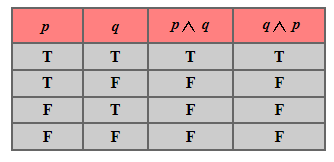
From this image, we see that p^q and q^p have the same truth value hence, are said to be logically equivalent.
This idea of if/then statements being logically equivalent is simple in theory, but often hard in practice, especially when the statements get more abstract.
For example, in her book Logic Made Easy, Deborah Bennett (2010) tells the story of a game of cards set up by the psychologist Peter Wason.
In the game, there are four cards:
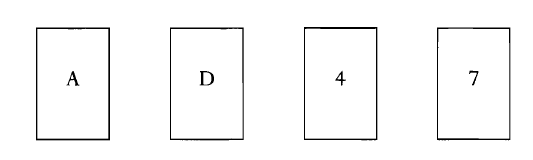
The rule is that if a card has a letter on one side, then it has a number. And for vowels, the number is even.
Participants are then asked to select the cards that can be used to disprove this rule (pause and think about it).
In the game, most participants select A and 4. They believe that if A has an odd number in the back, then it can be used to disprove the rule. And, if 4 has a non-vowel letter, then it can also be used to disprove the rule.
But, this is not entirely true. While A can be used to disprove the rule, D and 4 cannot because the rule says nothing about non-vowel letters. They could have an odd or even number; nobody knows for sure.
However, 7 can be used to disprove the hypothesis because if we flip it and find that it has a vowel letter, then the rule is automatically false.
Bennett notes that if/then statements are often complex because reasoning normally takes place within "linguistic structures" and expressions that encompass meaning.
It’s much easier to think about “every time I like sports, I like football” than “if I like sports then I like football.”
Rule 2: If P Then Q Doesn’t Mean P Causes Q, or Q implies P
When most people encounter if/then statements, they tend to believe that the consequent, p, causes the antecedent, q.
For example, most people will interpret the statement: "If it rains, then she will spoil her new shoes," to mean that the rain is the cause of the shoe spoilage.
However, this is an error of logical thinking. The statement shows a vague connection that cannot be used to determine causality.
Sure, rain might spoil her shoes, but it might not be the only cause.
Furthermore, it is not entirely true that shoes are only spoilt when there is rain.
So why is understanding this rule important?
Well, in life, many if/then statements usually confuse people, and lead to flawed deductions.
For example, we know that if you add silver nitrate to a salt, then it turns into a white precipitate. However, this does not mean that white precipitates are only caused by adding salt to silver nitrate. Other substances might produce the same reaction.
Rule 3: The Inverse of the Conditional Statement Takes the Negation of Both the Antecedent and the Consequent
Language is very tricky, and many people make mistakes when inverting conditional statements.
For this reason, it is considered a rule of thumb that when you’re given the statement, if p then q, we can deduce the inverse that takes the form: if not p, then not q.
For example, the inverse of the above example, "If it rains, then she will spoil her new shoes," is “if it does not rain, she will not spoil her new shoes.“
By now, you might have noted that this statement is logically equivalent to the converse “she will spoil her shoes if it does not rain,” and not the actual conditional statement.
This is because the actual conditional statement, "If it rains, then she will spoil her new shoes," still implies that there are other reasons that can be a cause for
Big Brain Time
Conditional statements are used everywhere we look. However, interpreting them at logical value can be hard due to the nuances of the English language and how our brain’s process information.
In this article, we’ve learnt the following about conditional statements:
If p can be used to infer q means p can be used to infer q. However, this does not necessarily mean that all instances of q will be caused by p.
If/then statements are logically equivalent if they have the same truth value.
If p then q doesn't mean that p causes q.
The converse of a conditional statement takes the form: if q then p.
The inverse of a conditional statement takes the form: if not p, then not q.
The inverse of a conditional statement is logically equivalent to its converse.